When jokers help, when they do not, and why exposure rules matter.
beginner29 mindiagramexercisecaseglossary
Learning Objectives
Understand that jokers are powerful but limited substitutes.
Notice exposed jokers and possible exchange opportunities.
Check group type before treating a joker as useful.
Use a table operation sequence for placing or evaluating a joker.
Repair common beginner mistakes around universal-wild assumptions.
Separate public joker concepts from protected annual-card specifics.
What jokers do and do not do
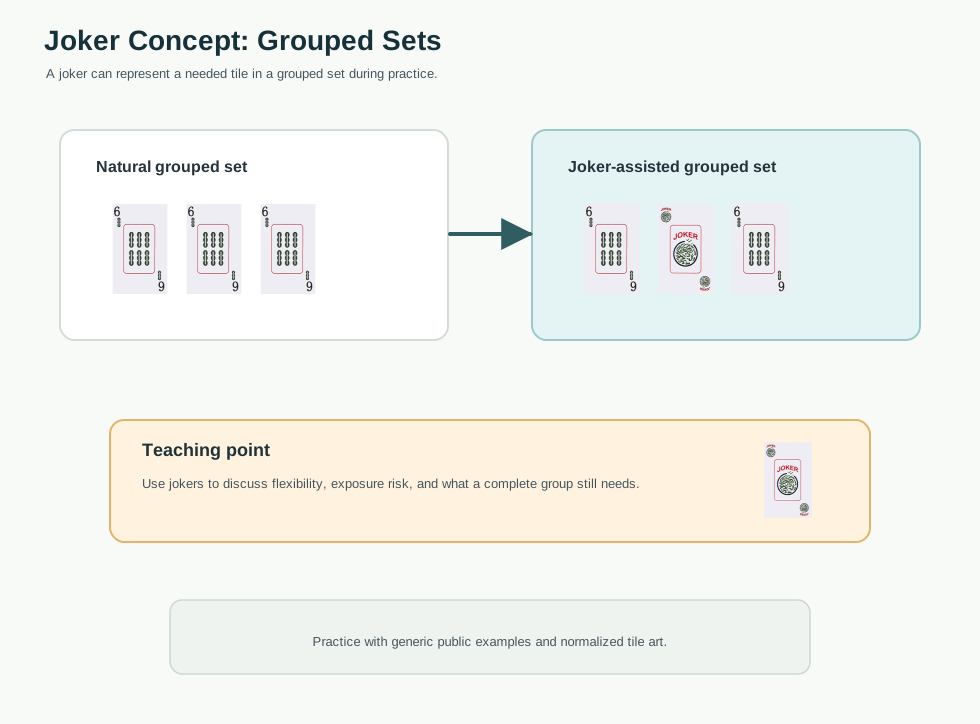
A generic joker concept visual. It does not represent an official annual-card hand.
A joker is powerful because it can help eligible grouped structures, especially when the learner is trying to complete something visible and coherent. It is limited because it is not a free replacement for every missing single, every uncertain tile, or every annual-card detail.
Use the beginner rule of thumb: group type first, joker second. If the group type or table situation is unclear, pause and check the official card, teacher, host, or table-agreed rule before treating the joker as usable.
Public practice should stay generic. Do not copy annual-card lines, score values, pattern notation, or exact hand structures to explain joker use. Teach the concept with neutral groups and route exact card-specific legality to the learner's own official source.
Check the group type first
Case: a tempting joker
A learner wants to use a joker as if it can stand for any missing tile in any situation.
What should they check first?
Show answer
Answer: Check the group type and the table consequence.
Jokers are strongest in eligible groups. Treating them as universal substitutes creates mistakes.
Do not treat jokers as ordinary singles.
Watch exposed jokers because they create information and possible exchanges.
Case: treating the joker as universal
A learner sees a joker and assumes it can stand in for any single tile in any situation.
What should they check first?
Show answer
Answer: Check the group type and whether a joker is allowed in that kind of group before using it.
Jokers create flexibility in eligible groups, but they are not a universal shortcut for every tile need.
Group type comes first.
Do not use card-specific examples to teach the basic rule.
Ask for official/table confirmation on edge cases.
A useful table operation is: identify the group you are trying to complete, ask whether that group type can use a joker, check whether using or exposing it gives away information, then decide whether the benefit is worth the cost.
Case: natural tile versus joker
A learner can complete a generic grouped idea with either the actual named tile or a joker-supported substitute. They are not sure whether the table reads those two choices the same way.
What should they notice?
Show answer
Answer: A natural tile and a joker-supported group can both help, but they may give the table different information.
The natural tile says the exact tile is present. A visible joker can invite exchange awareness and tells the table the group is supported by a substitute.
Natural tiles and jokers are not the same signal.
Visible jokers change table awareness.
Use generic examples instead of annual-card details.
Use jokers carefully at the table
Before placing a joker in a visible group, ask four questions: what group am I completing, is this group type joker-eligible under the table's rules, what information will the exposure reveal, and what happens if another player later notices the joker?
If a joker is exposed, keep the exposure neat and visible. Do not hide it, bury it in the rack, or treat it as private information. Once it is public, other players may use that visible information in their own table awareness.
After learning the basic joker habit, use the next lessons in order: joker exchange awareness for visible joker timing, read the card for private official-card study boundaries, and exposures and calling for the information cost of making groups public.
Case: exposed joker surprise
A learner exposes a group with a joker and is surprised that other players start watching it closely.
What should the learner understand?
Show answer
Answer: The exposed joker is public information and may create future exchange awareness.
Once a joker is visible, the table can track it. This is not unfair table pressure; it is part of the information cost of exposing jokers.
Exposed jokers are public.
Information cost matters.
The next lesson will deepen joker exchange awareness.
Case: unclear edge case
A learner is unsure whether a specific table situation allows a joker, and the answer seems to depend on exact card or table rules.
What should happen before teaching it as a rule?
Show answer
Answer: Pause and check the official card, teacher, host, or table-agreed rule without publishing the exact protected pattern.
Joker edge cases should be verified from the correct source. Public lessons should not turn exact annual-card details into reconstructable examples.
Edge cases need confirmation.
Do not guess from memory.
Do not expose protected annual-card details.
Practice cases with answers
Practice Case
What is the first question before using a joker?
Practice Case
Why do exposed jokers matter to other players?
Practice Case
Which public lesson example is safest?
Practice Case
What is the safest first question before using a joker in practice?
Practice Case
A visible joker in an exposure gives the table what kind of information?
Practice Case
Which table habit prevents most beginner joker mistakes?
Practice Case
A joker edge case depends on exact annual-card or table rules. What should the public lesson do?
Practice Case
Why should exposed jokers be kept visible and neat?
Common Mistakes
Treating jokers as universal wild tiles.
Forgetting that exposed jokers give information to opponents.
Using a joker before checking the group type.
Assuming a joker can repair every single missing tile.
Forgetting that a natural tile and a joker do not communicate the same table information.
Using annual-card-specific examples in public practice instead of generic group concepts.