Practice Case
What should a beginner do before starting an optional second Charleston?
Learn
A simple explanation of the passing phase used in American Mahjong.
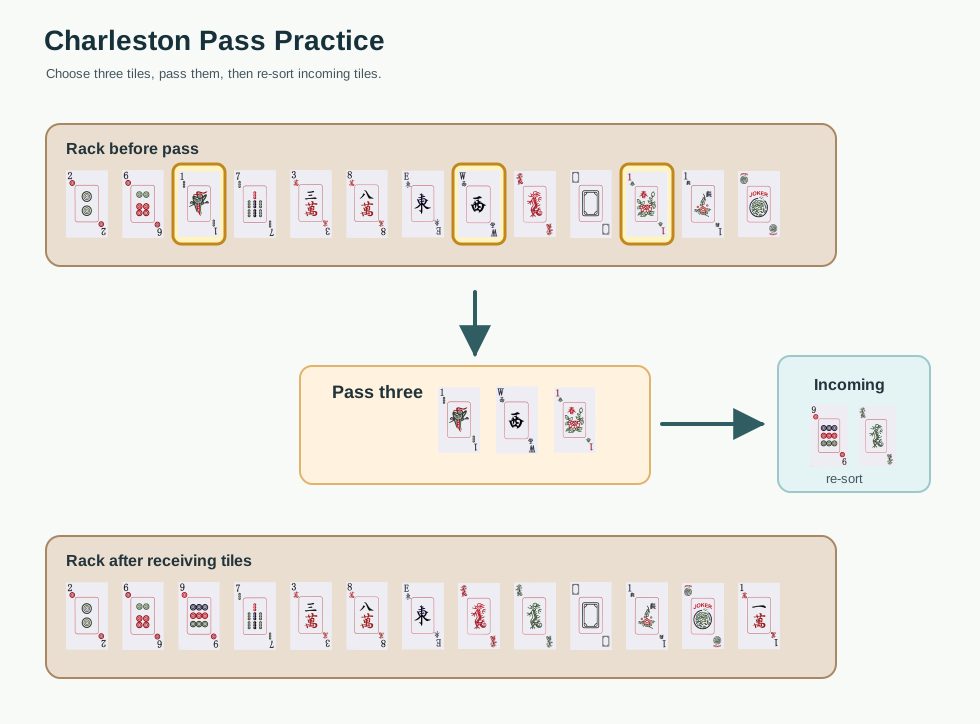
Treat the Charleston as a sequence of small evidence decisions. You are not trying to announce a final hand. You are trying to protect useful structure, release low-support tiles, and notice whether a direction is starting to appear.
A public lesson can teach this process without publishing annual-card targets. Say pair, cluster, flexible support, maybe, and release. Keep exact official-card hand text, notation, values, and layout private.
Many beginner tables teach the first Charleston rhythm as right, across, then left. If the table continues into a second Charleston, confirm the table convention before continuing. Do not assume a second sequence until the table agrees.
Use this pass-by-pass routine: name the direction, choose three low-support tiles, pass them, receive three tiles, sort the received tiles into keep/maybe/pass, and ask whether your tentative direction got stronger or weaker.
Practice Case
What should a beginner do before starting an optional second Charleston?
Use four labels: keep, maybe, pass, and caution. Keep obvious pairs, jokers, and flexible helpers. Mark isolated tiles as pass candidates. Leave maybe tiles alone until the rack gives more evidence. Put tiles that might help another player into caution, then compare them against your own weakest tiles.
A beginner-safe pass choice usually gives away less structure from your own rack. It is not a guarantee that the tile is harmless to everyone else. That is why the habit is cautious, not perfect.
Your rack has one clear pair, several related suit tiles, and three isolated singles that do not connect to the rest of the rack.
Which tiles should a beginner consider passing first?
Answer: Start with the isolated singles, not the pair or the joker.
Pairs and jokers are flexible. Unsupported singles usually give up less structure during an early pass.
After the first pass, you receive two tiles that support a suit cluster and one tile that is still isolated. You had planned to pass from that suit before seeing these tiles.
What should a beginner do before the next pass?
Answer: Reinspect the rack and update the pass candidates before committing to the next three tiles.
The Charleston changes the rack every pass. New support can turn a former pass candidate into a tile worth holding.
A learner has two isolated tiles and one maybe tile that could support a direction if one more related tile arrives.
Which tile should usually be considered first for the pass?
Answer: Start by comparing the isolated tiles before passing the maybe tile.
A maybe tile has at least a possible job. Unsupported singles usually cost less structure during the Charleston.
After two passes, one suit group has gained support, but your rack still has two unrelated singles and one tile that only might matter later.
Should a beginner lock into that suit group and pass every other tile automatically?
Answer: No. Treat the suit group as a tentative direction, then choose the next pass from the weakest current tiles.
The Charleston is still changing the rack. A stronger direction should guide the pass, but it should not make the learner ignore new support or break useful pairs.
You planned to pass a loose number tile next, but the three tiles you just received include two related tiles that now support it.
What is the best beginner response before the next pass?
Answer: Move that tile out of the pass pile for now and look for weaker isolated tiles instead.
Received tiles can turn a weak tile into useful support. The pass decision should reflect the rack after the receive, not the rack from the prior pass.
Use the rhythm pass, receive, inspect. Choose the current pass from the rack you actually have now, then inspect the three tiles you receive before choosing the next pass. This keeps the Charleston flexible instead of turning the first idea into a forced plan.
Some tables allow a blind pass in specific moments by passing along a received tile without looking or using it to complete your three. Treat this as a table-rule and timing question, not as a strategy shortcut. If you are unsure, ask before acting.
When the Charleston sequence ends, the table may move into a courtesy pass. Courtesy pass is a separate agreement step with its own etiquette, so this lesson only names the bridge and leaves the detailed routine for the next page.
A beginner hears another player mention a blind pass, but they are unsure when it is allowed at this table.
What is the right repair move?
Answer: Pause and ask the table to clarify the blind-pass rule and timing before passing.
Blind passing is not a substitute for knowing the table agreement. Asking prevents a fast mistake and keeps the table aligned.
A learner wants to explain their pass by naming an exact official-card target and why they no longer need a tile.
How should they speak instead?
Answer: Use process language: this tile has low support, or I am protecting a pair and a flexible cluster.
Process language teaches the habit without revealing protected card details or giving the table exact strategic information.
Practice Case
In a beginner Charleston, which tile type is usually the easiest first pass?
Practice Case
After receiving three new tiles, what should a learner do before the next pass?
Practice Case
Why should public lessons avoid annual-card-specific Charleston formulas?
Practice Case
What is the safest public way to explain a Charleston pass choice?
Practice Case
A learner is unsure whether a blind pass is allowed at this moment. What should they do?
Practice Case
Which routine best fits a beginner Charleston pass?
Practice Case
A learner has a promising direction after the first two passes. What should they do next?
The Charleston passes are complete. A learner still has two weak tiles but also wants to keep table pace calm.
What should they prepare for next?
Answer: Prepare for the courtesy-pass conversation and use the next lesson for the exact etiquette.
Courtesy pass is related to the Charleston but has its own agreement step. Bridging cleanly prevents beginners from blending every pass into one rule.