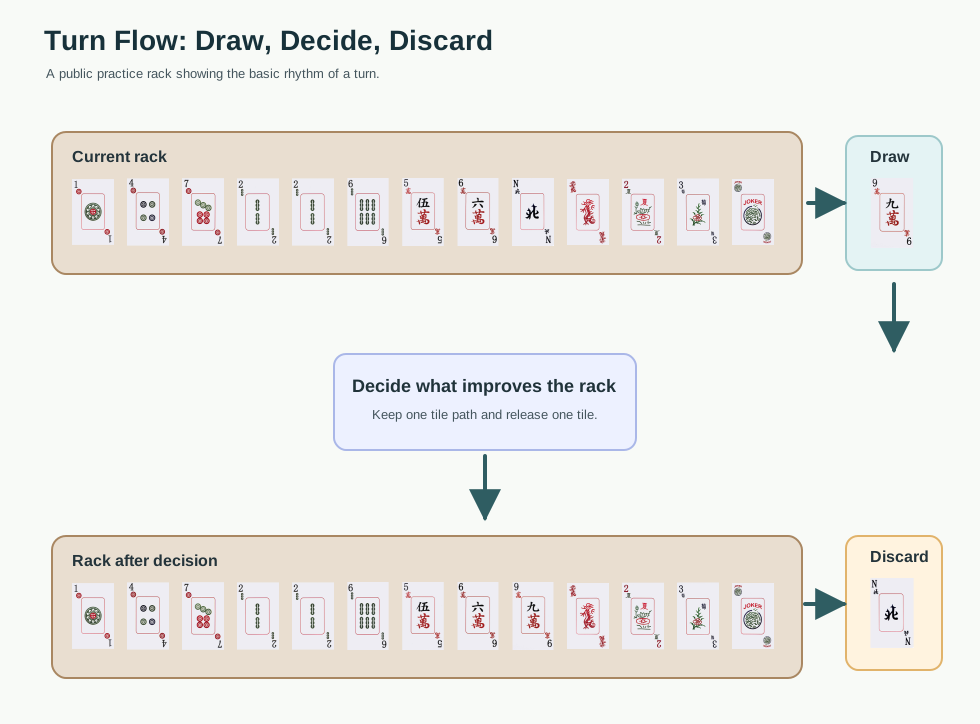
A beginner framework for choosing early discards without panic.
beginner28 mindiagramexercisecaseglossary
Learning Objectives
Choose early discards by looking for unsupported tiles.
Avoid discarding only because a tile feels unfamiliar.
Check rack evidence and visible table information before naming a discard.
Use a 30-second first-discard scan before naming a tile.
Explain why safer does not mean safe in early discard decisions.
Repair a rushed or regretted first discard decision without exposing private plans.
Start with a scan, not a guess
A discard decision sits between rack reading and the table's chance to react.
The first discard is not a race. Treat it as the first public decision after the Charleston or setup phase: settle the rack, separate obvious anchors from possible release tiles, and choose from evidence instead of discomfort.
Use a three-question check: what does this tile support, what would I weaken by discarding it, and what can the table already see? If a tile supports nothing and does not protect a flexible direction, it becomes a better discard candidate.
Keep annual-card specifics out of this public scan. The learner should use their own official card for exact target details; this lesson teaches the general discard habit of protecting support and releasing weak connections.
Run the 30-second first-discard scan
Step 1: protect anchors. Do not break a clear pair, useful duplicate, joker-supported group, or strong cluster just because another tile feels awkward. Step 2: notice flexible support. A single tile can still be useful if it connects to multiple nearby possibilities or a broad private direction.
Step 3: nominate two release candidates instead of one. Compare them by asking which has less duplicate support, fewer nearby relationships, and less visible-table encouragement. Step 4: glance at public information. Recent discards and exposures can make one candidate look weaker, but they do not make a discard risk-free.
Case: two weak candidates
A learner finds two possible first discards. One is completely separate from the rest of the rack. The other is single for now, but it sits near several related tiles and could support more than one private direction.
Which candidate should get released first?
Show answer
Answer: Usually release the completely separate tile first.
The single tile with nearby relationships still has flexible support. The better first discard candidate is the one with the least connection after the full scan.
Compare at least two candidates.
Single does not always mean unsupported.
Protect flexible support until evidence says it is truly weak.
Case: joker confusion
A beginner has a joker and feels tempted to discard it because they do not yet understand where it belongs.
What should replace that impulse?
Show answer
Answer: Pause and treat the joker as protected until a teacher or table-agreed rule explanation makes its limits clear.
Confusion is not evidence that a tile is weak. Jokers are special enough that beginners should not release them just to reduce uncertainty.
Do not discard from confusion.
Ask a rule question without revealing a full private plan.
Use exact joker limits from the learner's official or table-agreed source.
Check visible information without pretending it is safe
Visible information includes discards, exposures, and table actions everyone can see. It can help you notice whether a tile family has looked unwanted, whether an exposure suggests interest in a direction, or whether your candidate could be giving the table exactly what it has been showing.
Use careful risk language. A discard can be less connected to your rack or look lower-risk from public evidence, but you cannot know every hidden rack. Avoid teaching beginners that a discard is safe; teach them to say why it is the best available release.
Case: lower-risk is not safe
Recent discards make one candidate look less useful to the table, and no exposure appears to point toward it. A learner wants to call it safe.
What is the better table-language habit?
Show answer
Answer: Call it lower-risk or less connected, not safe.
Hidden racks can still need a tile. Honest risk language helps beginners make evidence-based choices without promising certainty.
Visible information is useful but incomplete.
Do not promise safety.
Explain the evidence behind the release candidate.
Repair pressure and regret
If the table is moving too quickly, use a neutral phrase before naming a tile: I need one scan, one moment for the rack, or let me compare two candidates. This protects learning time without announcing your hand direction.
If you regret a discard after naming it, do not explain your whole private plan. Let the table resolve any call window, then use the mistake as a repair scan on your next turn: what anchor did I miss, what visible clue did I ignore, and what release candidate should I compare next time?
Case: table pressure
A faster player says, Just throw something, while a beginner is still comparing two first-discard candidates.
What should the beginner do?
Show answer
Answer: Use a neutral timing phrase and finish the scan before naming a tile.
A short scan is part of a careful turn. The learner can protect table pace without discarding from pressure.
Use procedural language, not private strategy language.
Compare two candidates before speaking.
Speed should not erase the first-discard scan.
Practice cases with answers
Practice Case
Which tile is usually the better first discard candidate?
Practice Case
Before naming a discard, what should a beginner check?
Practice Case
Which phrase is most accurate before a first discard?
Practice Case
A faster player pressures a beginner to discard immediately. What is the best repair phrase?
Practice Case
What should a beginner do after regretting a named discard?
Case: the instant discard
A learner draws, sees a tile they do not recognize quickly, and wants to discard it immediately.
What repair habit should replace the impulse?
Show answer
Answer: Pause, name the tile family, check whether it supports a pair or cluster, then compare it with other weak candidates.
Unfamiliar does not mean useless. A quick support check prevents avoidable early mistakes.
Do not discard from panic.
Scan before naming the tile.
After discarding, pause so the table can call.
Case: the flexible single
A learner sees one isolated tile, but it is near several related tiles and could support more than one private direction. Another tile has no pair, no cluster, and no visible connection to the plan.
Which tile is the better first discard candidate?
Show answer
Answer: The tile with no pair, cluster, or visible connection is the better candidate.
A tile that looks single can still be flexible support. The first discard should come from weak evidence, not just from isolation.
Isolated is not always unsupported.
Flexible support is worth noticing.
Use rack evidence before naming the tile.
Case: visible table information changes the choice
Your rack has one loose tile that could still support a private direction, and another loose tile with no duplicate support. Recent discards show several tiles from the unsupported side of your rack, and no exposure suggests that side is becoming useful.
Which tile should a beginner consider releasing first?
Show answer
Answer: Consider releasing the loose tile with no duplicate support and weak visible-table evidence.
The first discard should combine private rack evidence with public information. A tile that still supports a plausible direction deserves another look before it is released automatically.
Do not discard a flexible tile just because it is currently single.
Visible discards can confirm that one candidate is weaker than another.
Use evidence, not speed, for the first discard.
Practice Case
Which sequence best describes the 30-second first-discard scan?
Common Mistakes
Mistake: throwing away a tile before checking the whole rack. Repair: scan pairs, clusters, jokers, and unsupported singles first.
Mistake: discarding only because a tile feels unfamiliar. Repair: ask what it supports before releasing it.
Mistake: ignoring visible table information. Repair: glance at exposures and recent discards before naming your tile.
Mistake: automatically discarding the first isolated-looking tile. Repair: check duplicate support, flexible categories, visible discards, and whether it still supports a plausible private direction.
Mistake: calling a discard safe because nobody has shown interest yet. Repair: say lower-risk or less connected, not guaranteed safe.
Mistake: apologizing by explaining your private plan after a bad discard. Repair: reset your scan silently on the next turn.