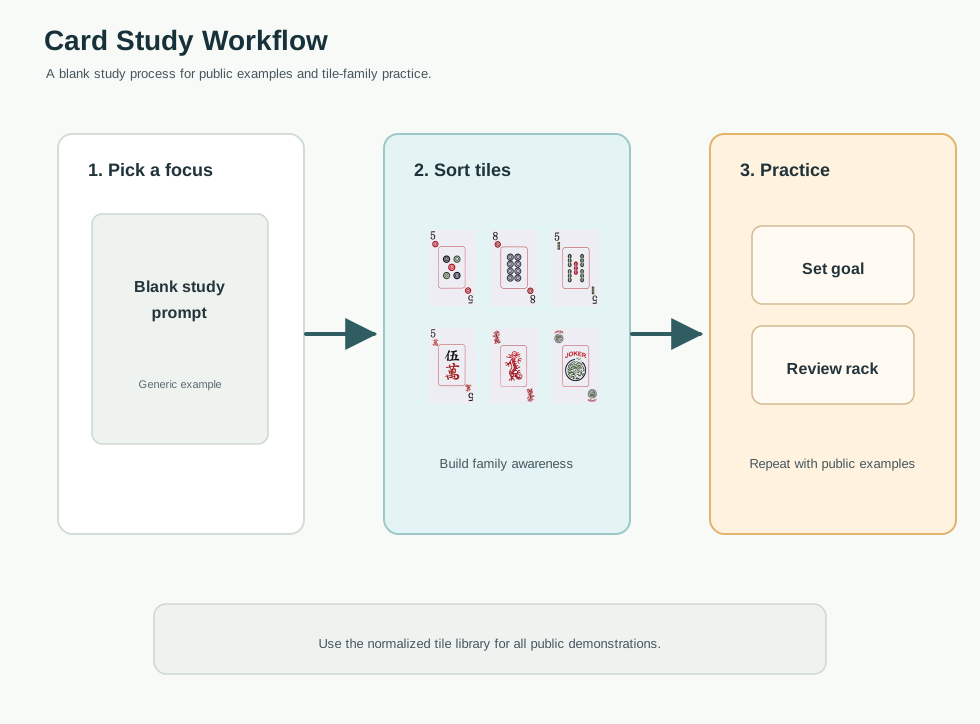
A safe way to study card organization as questions and habits without copying protected content.
beginner28 mindiagramexercisecaseglossary
Learning Objectives
Study card organization conceptually without copying protected details.
Use section awareness to reduce overwhelm.
Write public-safe study questions instead of substituting for the official card.
Turn a card section into a private study question and a public-safe practice habit.
Connect section study to rack evidence without naming protected annual-card targets.
Repair unsafe public notes, copied shorthand, and overbroad study sessions.
Study sections as questions
This workflow teaches how to study. It does not reproduce the annual card, its layout, hand text, notation, or values.
Public lessons can say how to use sections: scan the official card privately, ask what kind of tile evidence a section makes you notice, and pick a narrow practice goal. The exact section content stays with the official card.
A useful public-safe sentence is: I am studying this part of the card as a question, not copying its answers. The question can be about tile families, rack support, or a practice focus. The answers stay on the learner's own official card.
Keep the boundary bright. Do not recreate the order of sections, list the hands in a section, quote official shorthand, publish values, or build a worksheet that lets someone play without the official card.
Use the section study loop
Use this loop: 1. Choose one private card area. 2. Ask one broad question about what it makes you notice. 3. Compare that question to your rack evidence. 4. Verify exact details on the official card. 5. Write a public note only about the method or repair habit.
A safe public note might say, study one section for repeated tile-family questions, or compare two private possibilities against your rack. It should not list hands, copy official wording, recreate arrangement, or share values.
Case: one section, one question
A beginner opens the official card and feels pulled toward several different printed areas at once.
What should they do for a short study session?
Show answer
Answer: Choose one private section-level area and turn it into one broad study question.
One question reduces overwhelm and keeps exact details on the official card. The public lesson can teach the narrowing habit without publishing the card.
Narrow the study scope.
Keep exact content private.
Use questions rather than copied answers.
Connect sections to rack evidence
After a private section scan, ask what your rack can actually support. A section-level idea with no rack evidence is just a curiosity. A section-level idea with anchors, support tiles, or flexible groups may become a private direction question.
At the table, speak in process language: my rack has support for this private direction question, or I need to verify exact details on my official card. Do not announce exact targets or coach another player from protected card content.
Case: section idea without rack support
A learner likes a private section-level idea after looking at the official card, but their rack has little support for that direction.
What should they do next?
Show answer
Answer: Treat it as an interesting idea, then compare other private directions that match the rack more strongly.
Card study should respond to rack evidence. Chasing an unsupported section-level idea can create weak passes, awkward discards, and public overexplaining.
Rack evidence matters.
A private idea is not a commitment.
Do not publish the exact target to explain the choice.
Case: section study improves a table habit
During practice, a learner uses private section study to notice that their rack keeps pointing toward one broad kind of evidence.
What public-safe note can they write?
Show answer
Answer: Write the habit: I should sort that kind of rack evidence earlier before choosing a direction.
The note improves table play without naming protected hands, layout, values, or shorthand.
Turn card study into a table habit.
Write the repair, not the protected answer.
Exact verification stays on the official card.
Repair unsafe section notes
Unsafe notes often include copied shorthand, values, exact section order, full hand lists, or enough examples to reconstruct a protected area. A safe rewrite says what the learner should do: scan privately, ask a broad question, compare to rack evidence, and verify exact details on the official card.
In a study group, keep shared notes procedural. Each player can look at their own official card for exact content. The shared document should contain prompts like choose one private section-level question or compare the private shortlist to your rack.
Case: copied shorthand in shared notes
A study group starts writing official shorthand and values from the card into a shared practice document.
What should replace that shared note?
Show answer
Answer: Replace it with a method prompt: choose one private section-level question and verify exact details on each player's official card.
The group keeps the learning workflow while removing reconstructable card content.
Shared notes should be procedural.
Do not copy official shorthand or values.
Each player verifies exact details privately.
Case: coaching too specifically
A learner wants to help another player by naming exact protected targets from a card section.
What is the safer coaching boundary?
Show answer
Answer: Use process guidance only, such as sort your rack evidence and check your official card privately.
Process guidance helps without exposing protected targets or creating a replacement-card explanation.
Process guidance is safer than target naming.
Exact targets stay with the official card.
Avoid coaching that reconstructs protected content.
Practice cases with answers
Practice Case
Which public note is safe for a lesson about card sections?
Practice Case
A beginner feels overwhelmed by the official card. What should they do first?
Practice Case
Which shared study note is safest?
Practice Case
A private section-level idea has no rack support. What should a beginner do?
Practice Case
What should a learner do when a public note starts to recreate card structure?
Practice Case
Which table phrase keeps section study spoiler-safe?
Case: the helpful study group
A group wants to discuss a card section during practice without sharing exact hand lines in their public notes.
What should they write down?
Show answer
Answer: Write the study method and the decision question, then check exact content on each player's official card.
The method is public-safe. Exact card details should remain in the official source.
Discuss navigation and habits.
Do not recreate protected card content.
Use private official materials for exact verification.
Common Mistakes
Mistake: turning public notes into a substitute card. Repair: keep exact hand content in official materials.
Mistake: trying to learn every section in one sitting. Repair: choose one study question at a time.
Mistake: copying official shorthand into shared notes. Repair: describe only the learning method in your own words.
Mistake: treating section awareness as permission to recreate the card layout. Repair: discuss navigation without reproducing arrangement.
Mistake: studying sections without looking at rack evidence. Repair: ask which private section-level idea your rack actually supports.
Mistake: coaching another player's exact card target. Repair: use process language and send exact verification back to each player's official card.